Understand how schools transform transactional donations into community-centered giving experiences.
Many K-12 schools send donors to basic, nondynamic forms that can leave donors feeling like they’re giving into a void.
Holman Gao, CEO and founder of Boost My School, has experienced this frustration firsthand. When he wanted to donate to his Maryland high school while living in San Francisco, the school told him he’d have to mail a physical check. He waited months to obtain his checkbook, then had to physically deliver the check through a friend during a holiday visit.
Holman was shocked by how outdated the giving experience was, with no follow-up or insight into who else was donating or how donations were used. The frustration sparked an idea: Shouldn’t it be easier to donate? And shouldn’t everyone at the school understand the impact of their gift on their shared community?
Schools were missing out on the storytelling that could make their community ties stronger. Holman wanted to help them bring a warm, interactive, human element front and center to their development strategies.
Busy advancement teams often default to sending donors to static forms that don’t reflect what makes their school special. In an effort to keep forms simple (and prevent donor drop off), they may leave out information about impact, where the money’s going, or who else is involved because they want the prospect to give as quickly as possible. Even if they do include information about where donations go in emails or mailers, those static formats prevent donors from seeing who else is giving in real time.
Pressed for time, many teams also choose to focus on major gifts only—not realizing a lack of overall engagement, including smaller gifts, makes the school look less attractive to major donors.
In both cases, what’s missing is a sense of deeper community ties—the very thing that makes K-12 schools uniquely positioned for exceptional giving success. Unlike massive universities or distant nonprofits, school communities are uniquely intimate ecosystems. Donors here are more likely to recognize other people who participate in giving.
Yet most schools miss the chance to emphasize these natural advantages due to time or resource constraints—or the erroneous belief that getting people to go from appeal to form as quickly as possible is the best way to convert visitors into donors.
When donors lack a deeper sense of being part of a culture of philanthropy, participation rates fall, leading to lower contributions overall.
Holman believes in leveraging what K-12 schools already possess: tight-knit communities with multi-generational relationships and shared emotional connections. Even the largest independent and Catholic schools possess intimate environments where everyone truly knows everyone. Instead of hiding community involvement, successful schools make it visible and celebratory.
One way to tap into that sense of community is through more engaging web pages for your advancement initiatives. At Boost, we help schools set up landing pages with tools that update in real time, such as:
This approach builds momentum and warmth into your efforts in a way that static content can’t show.
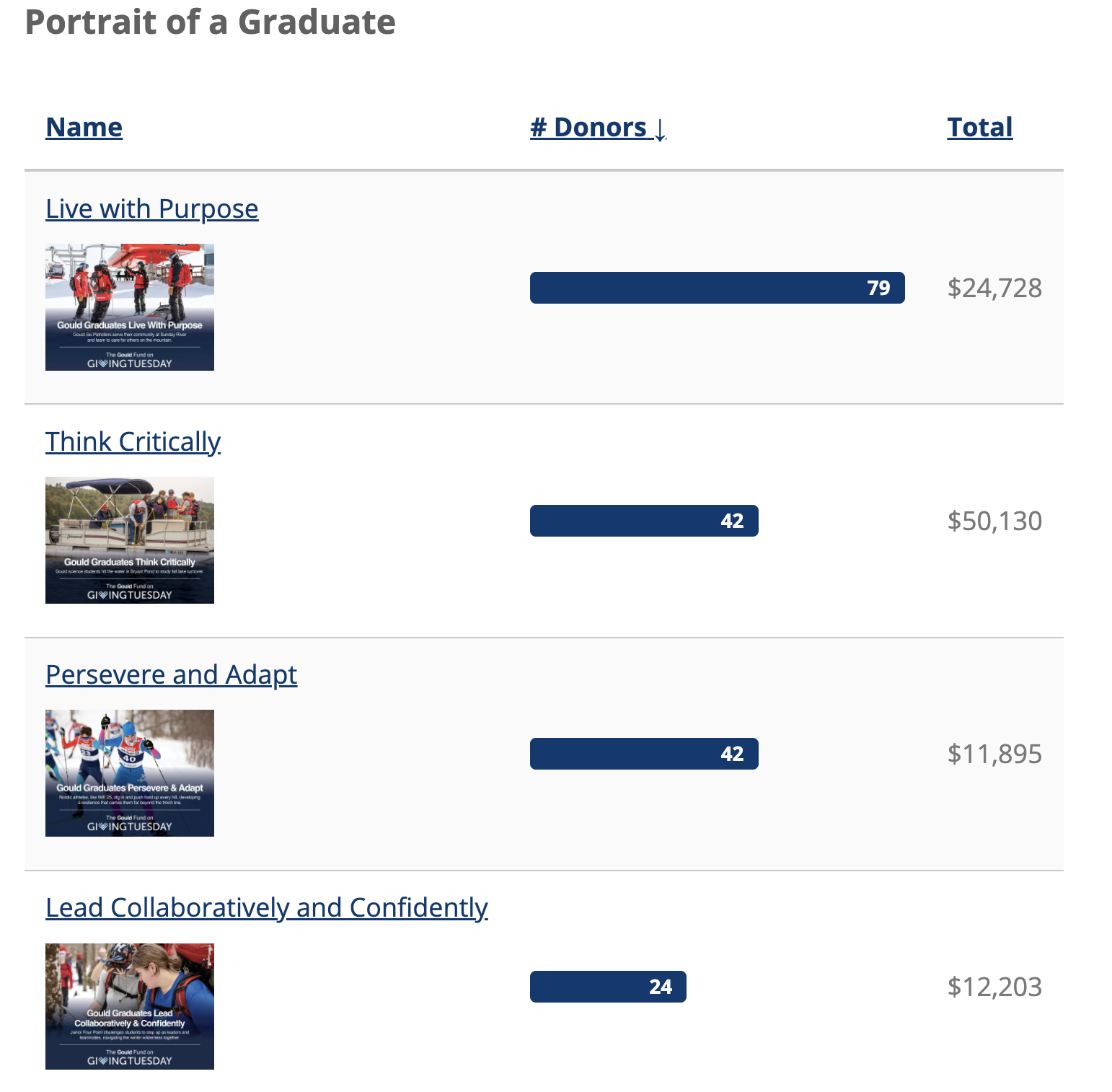
The result is experiential giving—when donors feel connected to something larger than themselves, because they see giving as a shared community experience, rather than just a financial transaction.
The difference is emotional connection. With experiential giving, donors aren't just sending money to a cause—they're joining their community in supporting students in a way that feels fun, visible, and meaningful. It's the difference between "I gave $50" and "I gave $50 with 200 other parents to help our kids have new lab equipment, and I saw my friend Sarah give too."
Shifting from transactional to experiential giving doesn't require massive budget increases or complex tech implementations. Instead, it demands a strategic reframe in how advancement teams think about donor relationships.
Working with more than 250 schools on a wide variety of giving initiatives, Holman has seen that the most successful schools take the following steps to leverage their existing community connections.
Imagine you get this email during a busy holiday season:
Sent to: List of all potential donors
Subject: Support Our Annual Fund Today
Hi,
Our Annual Fund is now open. As you may know, the Annual Fund helps cover the gap between tuition and operating expenses. Each year, we ask all families to contribute so we can continue offering quality programs.
Please consider making a donation of $50, $100, or $250. Every dollar makes a difference and helps us reach our goal. We rely on your participation to keep our school running.
You can make your gift online using this link: {{GivingLink}}
Thank you in advance for your support.
Sincerely,
The Advancement Office
Generic appeals like this one miss the specific emotional connections that drive giving. Effective segmentation goes beyond basic demographics to capture the relationships that actually matter to donors.
"The easiest one is always parents versus alumni," Holman notes. "And then you can also segment sports team interest. Or with some boarding schools, it's by their dorms."
Consider this rewrite:
Sent to: Alumni all-star hockey players, parents of the hockey team, and people who formerly gave to athletic programs
Subject: From Coach Daniels: Help Our Players Skate Further This Year
Hi {{FirstName}},
I hope you’re doing well. Every time I’m out on the ice with our boys, I see small moments that remind me of the teams you played on — the early morning practices, the locker room jokes, the long bus rides, and the pride that came from wearing our jersey. Those memories still live here.
I’m writing today because the next generation of players is working hard to build something just as special. They’re pushing themselves in the weight room, running new systems, and showing up for each other in ways that would make you proud.
This year’s Annual Fund is a big part of keeping that experience strong. Support from hockey alums like you helps us upgrade worn equipment, fund travel to tougher competition, and make sure cost never gets in the way for a committed player who wants to be part of the team.
If you’re able, I’d be grateful for your support. A gift of any size truly makes a difference in the lives of our student athletes, and it sends a message to the team that our hockey family still has their back.
You can make your gift here: {{GivingLink}}
Thank you for everything you did to build this program, and for continuing to be part of it. If you’re ever back in town, come by the rink. The door is always open and the coffee is usually warm.
Coach Daniels
Head Hockey Coach,
{{SchoolName}}
Holman notes that schools that succeed in their appeals often identify 3-5 segments that represent different ways people connect emotionally to your school. Then, they develop messaging that speaks to each group's unique interests and relationship with the broader community.
.png)
Traditional campaigns hide community participation behind the scenes. Donors give in isolation, never seeing the collective effort they’re a part of.
Community-centered giving makes participation visible and celebratory. For example, allow participants to see who else is giving in real time, based on geography, class year, or even name. This builds a sense of pride and ownership over a gift while encouraging others to participate.
You may even encourage a little healthy competition with leaderboards that let donors see participation at the segment level.

It’s also important to allow community members to share why they're giving and what the school means to them. Whether by allowing comments on the advancement page itself, or by making it easy to share participation on social media, this storytelling can create ripple effects that reach far beyond your initial ask.
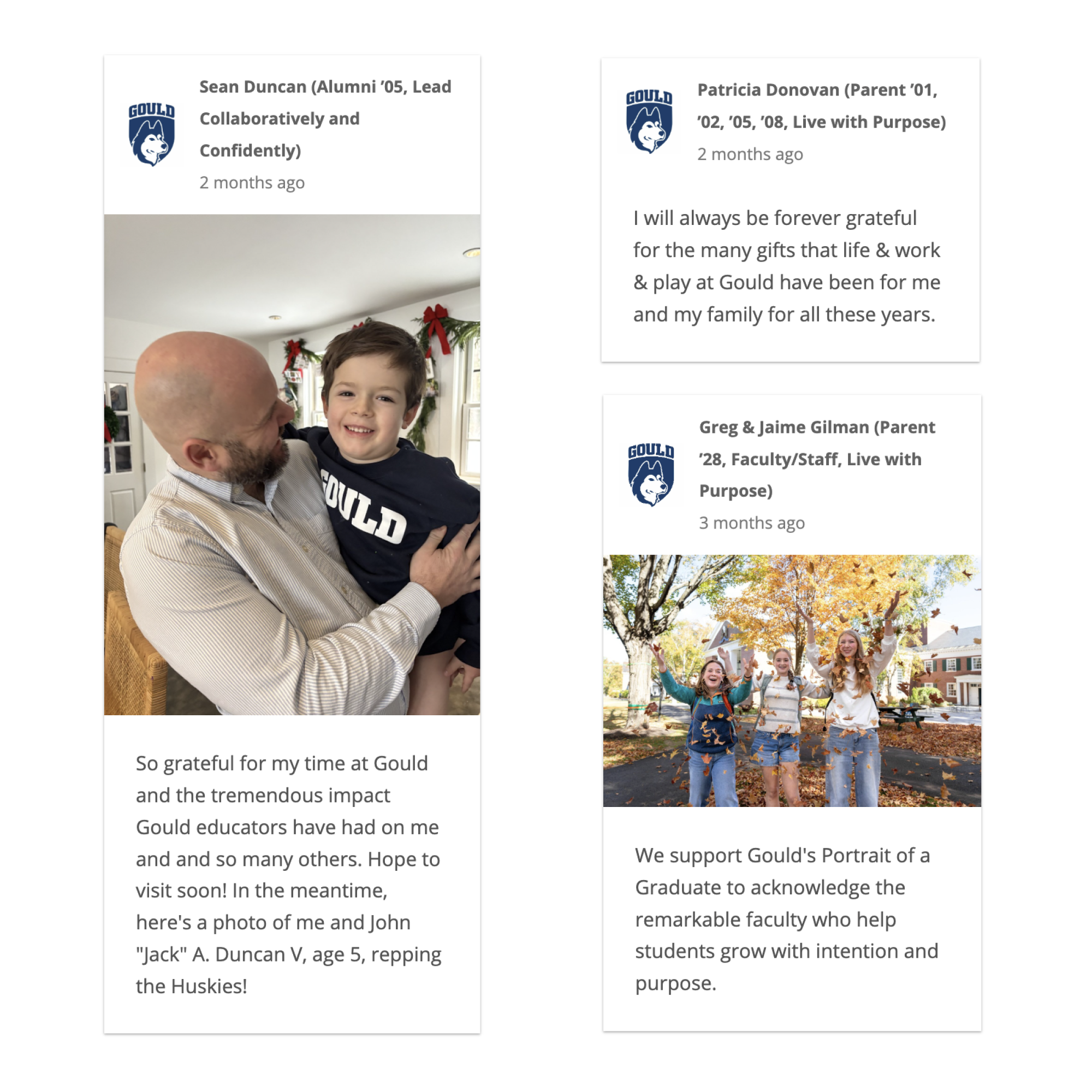
Members of the community are interested in how others are giving. This visibility reassures individuals they're part of something bigger, providing social proof that encourages additional giving and creating content that showcases your school's impact.
Relationship-building shouldn’t stop when the money comes in. Use the data you collect about donors to fine-tune personalized messaging that helps you maintain engagement between formal asks.
This will allow you to customize follow-up communications based on the giving motivations donors share. For example:
More broadly, leverage publications like school papers and alumni magazines to show givers the student achievements their gifts helped support.
Schools implementing community-centered advancement programs see immediate increases in donor engagement and long-term increases in participation.
The improvement is dramatic. The strongest pages hosted on Boost My School see up to 50% conversion rates (as measured by unique visitors coming to the giving page and converting into donors), as opposed to a transactional form with only a 17% conversion rate.
But the real value lies in building sustainable donor relationships.
Community-centered giving creates compound growth as engaged donors become advocates who influence others. Longstanding donors continue to stay closely connected with their school, while new families see existing participation and feel healthy pressure to contribute. Consistent engagement from donors at every level, from $25 onward, showcases the value of giving and encourages outsized contributions from major donors.
“A few days into our campaign, parents of an alumnus from the class of 1990, inspired by the momentum, offered to match every dollar raised from that point forward—tripling the impact of every gift.”
— Gould Academy
You don’t need sophisticated technology or larger budgets to change from static to experiential campaigns that drive meaningful results. What you do need is to recognize that your school community is already your greatest asset.
Q: What if our donor data isn't sophisticated enough to create detailed segments?
A: Begin with simple segments like parents versus alumni, or graduation decades. Natural affinity groups often don't require complex data—sports teams, academic programs, and class years are all emotionally meaningful to donors. With Boost My School, schools can easily streamline data collection.
Q: How do we handle the "I already pay tuition" objection from parents when encouraging donations to my school?
A: Use community visibility to showcase the funding gap between tuition and actual program costs. When parents see other families contributing to specific programs their children benefit from (arts, athletics, technology), it reframes giving as investing in enhanced educational experiences rather than paying extra fees.
Q: What if some families or alumni don’t want their names visible on public leaderboards or donor lists?
A: Respect for privacy and community celebration can work together. Most giving platforms, including Boost My School, let people choose whether to give publicly or anonymously. You can still show total participation rates by class or affinity group without listing individual names. Many schools find when people see classmates participating (even anonymously), it encourages them to join in.